




 VIEW
VIEW
Rising Demand for Veterinary Surgeons in India: A 2026 Career Outlook
27 Apr, 2026
Relationship between India and animals—livestock, companion animals, wildlife, and aquatic species is both large, intricate, and economically important. However, over the decades, the veterinary occupation was given much less institutional consideration than it deserved.
That is shifting at a rather rapid rate. India already shows a trend where there is a constant shortage of supply in relation to the demand for qualified veterinary surgeons and animal health professionals in 2026. This is one of the most attractive career access points in the profession in recent memory to students who are considering a bachelor's degree in veterinary science and animal husbandry.
What Is the Dynamic of the Veterinary Demand in India?
Several forces are coming together at the same time to generate this demand, and being familiar with them will enable future students to recognize why this career path has real long-term sustainability. India has the highest number of livestock in the world. All cattle, buffalo, goats, sheep, and poultry are an agricultural asset of hundreds of thousands of crores. The disease management, health, and productivity of these animals have a direct influence on the livelihoods in the rural areas and national food security. Qualified veterinary professionals are needed at all levels of government programs aimed at the development of dairy, poultry, and fisheries.
At the same time, the companion animal business in urban India has changed. There is a significant increase in the number of homes that own dogs, cats, and exotic pets over the last ten years, especially in major cities and Tier-II cities. This has not only led to a need for general veterinary practitioners but also specialists in orthopaedic surgery, dermatology, oncology, and diagnostic imaging.
Students majoring in veterinary science and animal husbandry are today getting into a profession that is rural agricultural practice, urban clinical practice, civil health, food safety inspection, pharmaceutical research, and wildlife preservation—a scope of occupation that even few other science-based careers can offer.
The Public Health Dimension: Why Veterinary Science is Important beyond Animal Care
Importance of veterinary medicine to the well-being of the population is one of the least recognised aspects. Most of the emerging infectious diseases in human beings are of zoonotic origins, they start in animals and jump over the species barriers. Rabies, bird flu, brucellosis, and recently, new viral dangers have all shown how the health of animals and human health cannot be separated.
The government of India has explicitly accepted this relationship by its adherence to the One Health paradigm, which is an interdependent system of human health, animal health, and environmental health. To put this framework on a large scale level, veterinary professionals are needed within the institutions of public health, surveillance, and policymaking.
Rural Veterinary Practice and The Livestock Economy
Main field of veterinary practice is still in rural India. States have a network of veterinary dispensaries, polyclinics, and mobile units, and these facilities are constantly short of qualified practitioners. Government service is a major and consistent career option among graduates of a Bachelor of Veterinary Science and Animal Husbandry program, and a chance to directly impact rural populations.
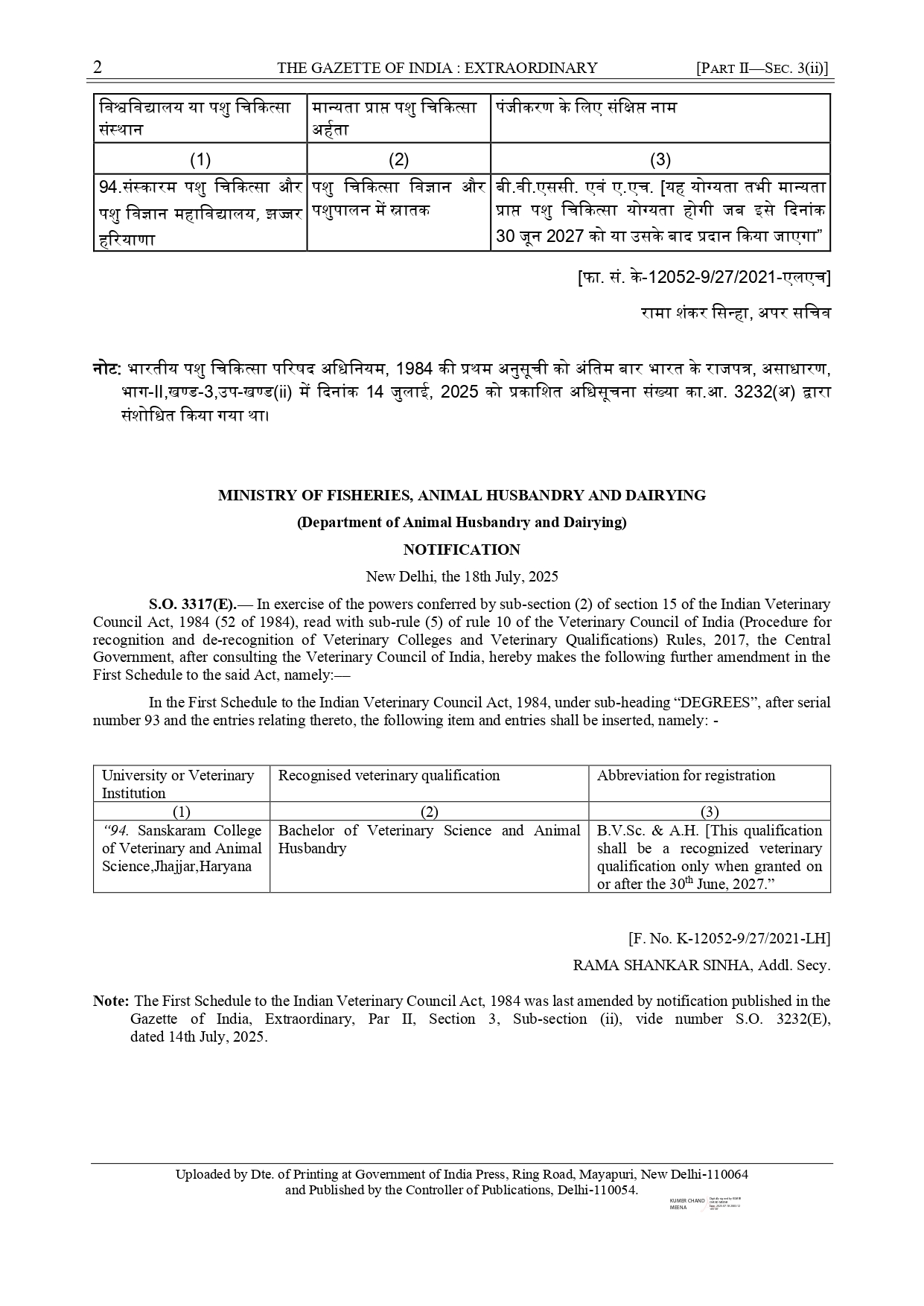
Best university of Haryana in the field of bachelor degree in veterinary science and animal husbandry, is generating graduates who are capable of working in these positions—people who not only know clinical medicine but also the nutrition of animals, reproductive health, herd management, and disease surveillance at the community level.
Outlook: Future of Veterinary Careers (2026) Emerging Opportunities
In addition to traditional clinical and government professions, the 2026 veterinary profession is branching out to areas that would have been considered marginal ten years ago. India is among the fast-growing animal pharmaceutical and biological industries. Firms creating vaccines, antibiotics, anti-parasitic drugs, and nutritional supplements for animals are aggressively hiring veterinary graduates to work in these fields in research, regulatory, quality assurance, and medical marketing. These jobs have competitive pay and work conditions comparable to those in human pharmaceutical jobs.
Another frontier is aquaculture. One of the largest fish and shrimp producers in the world is India, although management of fish and shrimp disease is now a specialized field with specific career opportunities. With their bachelor's degree in veterinary science and animal husbandry program, students who gain skills in the health of aquatic animals are venturing into a field where there are no trained professionals in the acute sense of the term.
Although of a lower volume of practice, wildlife veterinary work has great professional prestige and ecological value. Veterinary skills are needed in forest departments, national parks, and conservation NGOs to manage the health of the population and the translocation and rehabilitation of injured wildlife. Universities of Haryana that design their veterinary programs to introduce the student to this whole spectrum of options (instead of training them to work in the traditional farm animal practice) are really training the students to work in the profession as it is today.
Sanskaram University: Preparing Veterinary Professionals With Richness and Intelligibility
Veterinary science programs at Sanskaram University, located in Haryana, have been designed with a view to producing graduates who are clinically competent, scientifically competent, and professionally diverse. The curriculum of the university combines animal husbandry, clinical training, and public health with a new specialization in a systematic structure that indicates the real requirements of the profession. Laboratories, clinical placements, and field placements expose students to practical experience, helping them to become competent at the beginning of their careers.
Conclusion
This is no longer a profession of choice in India, where veterinary medicine is not the last resort. It is one field that has intellectual richness, professional variety, social applicability, and economic security in the same measure. The course of action to take in this area, and to equip oneself to do so, by the appropriate school, is one that students in 2026 will have no hesitation in making.
Frequently Asked Questions (FAQs)
Q1. Which career opportunities can one get with a bachelor's degree in veterinary science and animal husbandry?
Graduates have an opportunity to work in clinical practice, government veterinary service, pharmaceutical research, health management of aquaculture, wildlife conservation, and food safety inspection in India and abroad.
Q2. On average, what is the length of a bachelor's degree in veterinary science and animal husbandry?
The undergraduate veterinary science and animal husbandry program is a five-and-a-half-year course, which has a mandatory one-year internship that equips students with practical clinical and field experience.
Q3. Why do students want to attend the best university in Haryana to receive an education in veterinary science?
Best University of Haryana with a structured clinical training program, qualified faculty, and industry exposure, which enable graduates to be ready to enter into the government, private, and research-based career pathway in veterinary.
Q4. Why is Sanskaram University a good option for veterinary science aspirants in Haryana?
Sanskaram University provides a well-rounded veterinary program, practical clinical education, and faculty experience that provide students with knowledge and skills that are essential in a successful career in the profession.






.png)